


Improving stability of sensitive drug products through lyophilization
August 7, 2026Scale-up starts at formulation: How early lyophilization decisions determine manufacturability
Formulation and cycle decisions that can reduce scale-up risk, accelerate tech transfer and protect regulatory confidence

Lyophilization scale-up is one of the most predictable challenges in biologics and diagnostics development, because the factors that determine whether a process scales successfully are almost all established before scale-up begins. Formulation composition, cycle parameters, design space and process documentation each determine whether scale-up, tech transfer and regulatory submission proceed on schedule or require costly rework. Developers who identify the highest-risk decisions early and address them will build development programmes that transfer cleanly, produce specification-compliant batches and support robust regulatory submissions.
The scale-up gap: why lab cycles behave differently in commercial manufacturing
Scale-up variability in lyophilization has three principal causes: differences in heat and mass transfer, the effect of the GMP environment on ice nucleation, and the interaction of container-closure and loading configuration with scale.
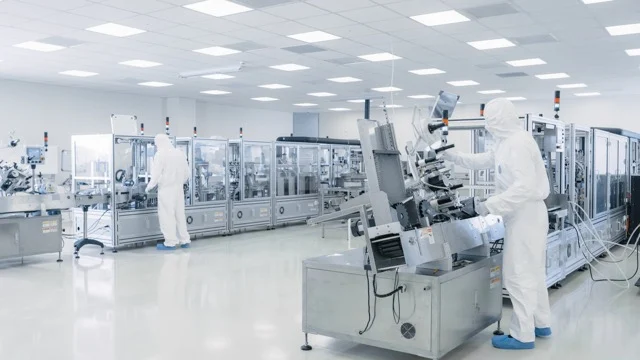 In a small laboratory freeze-dryer, heat reaches the product through conduction from the shelf and vapor moves freely to the condenser. In a commercial dryer with tens of thousands of vials, the geometry changes: edge vials receive more radiant heat than centre vials, creating temperature gradients across the batch, while vapor flow paths become longer and more complex. A cycle designed to keep product temperature below Tc at lab scale may produce temperature excursions in some vials at commercial scale, leading to collapse or meltback in a subset of the batch.
Commercial manufacture requires aseptic processing in Class A cleanrooms, while laboratory lyophilization is typically performed in non-classified conditions. The higher cleanliness suppresses particulate nucleation, producing greater supercooling before ice formation, smaller ice crystals, denser cake structure and higher resistance to vapor flow during primary drying. The consequence is a longer drying time at commercial scale - a predictable outcome that is frequently overlooked during development. Vial dimensions, fill volumes and batch loading configuration interact with scale in similar ways and should be characterized during development rather than discovered at manufacturing scale.
The formulation decisions that determine scalability
Several formulation parameters have significant influence on whether a lyophilization process scales successfully:
The most consequential formulation decision for scalability is the maximum allowable product temperature during primary drying, governed by the collapse temperature (Tc) or eutectic melting temperature (Te). Formulations with Tc below around -35°C have a high probability of scale-up problems, because commercial dryers have less precise temperature control than lab-scale equipment, and heat transfer variability across a large batch makes it harder to keep all vials within such a narrow thermal margin. Formulations designed with a higher Tc, through excipient selection, provide the operating margin that commercial production requires.
A second critical variable is cake resistance (Rp), determined by excipient selection and the freezing protocol. Bulking agents such as mannitol influence the physical structure of the frozen matrix and therefore the porosity and resistance of the dried cake. Resistance is further set by ice crystal size and morphology, which is determined by the freezing protocol. Optimizing the freezing step, including annealing where appropriate, to produce a cake with acceptable resistance is one of the most direct ways to build scalability into the process from the start.
Fill volume and concentration decisions also affect heat transfer at the vial level and should be modeled for their scale-up implications before being fixed.
Designing a scalable lyophilization cycle: robustness, design space and annealing
Producing product at lab scale and producing consistently at commercial scale require different things from a lyophilization cycle. At lab scale, small batches and controlled conditions mean that a narrow operating window is rarely exposed. At commercial scale, batch-to-batch variability, equipment drift and environmental differences mean that a process operating close to its limits will eventually exceed them.
Robustness and design space
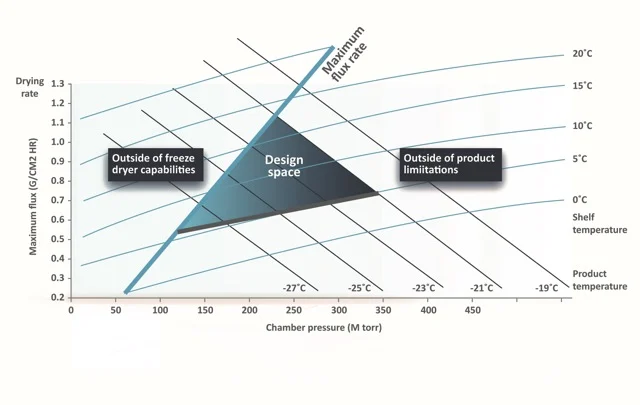
Robustness is built by establishing and documenting the design space: the range of process parameters (shelf temperature, chamber pressure, ramp rates) within which the product consistently meets its quality specifications. The wider the design space, the more variability the process can absorb without producing out-of-specification product. Establishing the design space requires systematically testing the boundaries of acceptable performance during development, rather than assuming they will hold at scale.
Annealing and ice morphology
At commercial scale, primary drying time directly affects throughput, energy consumption and batch cost, so there is an advantage to any technique that shortens drying time without compromising product quality. Annealing is one such technique. Introducing an annealing step during freezing (holding the product between Tg' and the freezing point for a defined period) encourages Ostwald ripening: the growth of larger, more uniform ice crystals. The resulting cake has lower resistance to vapor flow, shorter primary drying time and more consistent residual moisture across the batch. Whether to include annealing should therefore be evaluated during process development.
Design space, process characterization and regulatory confidence
‘Design space’ is both a scientific concept and a regulatory asset. Scientifically, it defines the operating window within which the product consistently meets its critical quality attributes. In regulatory terms, it is the evidence base that supports the marketing authorization, enables post-approval process changes without full revalidation, and gives manufacturing teams the documented authority to manage process variability within defined limits.
The ICH Q8(R2), Q9 and Q10 guidelines, together with FDA guidance on Process Analytical Technology (PAT), require that process understanding be built through systematic characterization and risk assessment, and that a design space be established before commercial manufacture begins.
Establishing design space requires thermal characterization of the formulation (Tc, Tg’, Te), cycle development across the range of parameters that affect product quality, and analytical validation linking process parameters to product outcomes. BTLLC’s R&D analytical services build this evidence base as an integrated part of cycle development, ensuring the design space established during development translates directly into regulatory submission documentation.
Scale-up success is earned in development
 The decisions that determine whether a lyophilization process scales successfully are almost all made before scale-up begins. Formulation composition, cycle design, design space and process documentation are part of the manufacturing strategy, expressed in the language of development. Developers who have established a robust design space and documented their process thoroughly also transfer faster - the design space document tells the receiving manufacturing team what parameters matter, what ranges are acceptable, and what analytical evidence demonstrates quality.
Biopharma Technology LLC’s pharma CDMO and diagnostic CDMO services cover the full development pathway: from formulation and thermal characterization through cycle development, design space, stability studies, scale-up and tech transfer to contract manufacturing. All work is conducted from our ISO 9001 and ISO 13485 certified facility in Carlsbad, California, with full client IP ownership throughout. To discuss your lyophilization development programme and understand what scale-up will require at your current stage, schedule a 30-minute technical consultation with our lyophilization scientists. Contact the BTLLC team to get started.
You may also find these resources useful: Understanding thermal analysis in lyophilization development | What to look for in a lyophilization CDMO partner | Improving stability of sensitive biological products through lyophilization
Frequently asked questions: lyophilization scale-up and manufacturability
When is the right time to start planning for lyophilization scale-up?
At the formulation stage, before excipients, buffers and fill volumes are fixed. The decisions that most affect scalability (collapse temperature, cake resistance, design space width) are made during early development and are significantly less costly to address then than after scale-up has begun. Developers who consider manufacturability from the first formulation decision reach commercial scale faster and with fewer surprises than those who treat scale-up as a later-stage activity.
What formulation decisions carry the highest scale-up risk in lyophilization?
Collapse temperature (Tc) and cake resistance carry the highest risk. Formulations with Tc below around -35°C have limited thermal margin for commercial manufacturing variability, and high cake resistance lengthens primary drying and makes uniform residual moisture harder to achieve at scale. Both are established during formulation development and are costly to change afterwards.
What is lyophilization design space and why does it matter for scale-up?
Design space is the documented range of process parameters within which the product consistently meets its quality specifications. A wide design space absorbs the variability of commercial manufacturing; a narrow one cannot. ICH Guidelines require design space to be established before commercial manufacture begins.
What is the difference between lyophilization scale-up and tech transfer?
Scale-up is the process of moving from a small development batch to a larger commercial batch, typically within the same facility or dryer. Tech transfer is the process of moving a developed cycle to a different site or dryer, requiring equipment characterization, cycle parameter translation and qualification runs at the receiving site. Both are significantly faster and more straightforward when the development cycle has been built on a robust, well-documented design space.
What documentation is needed for lyophilization scale-up and regulatory submission?
Scale-up and regulatory submission require a documented design space, process characterization data linking cycle parameters to product quality outcomes, residual moisture data from Karl Fischer titration, stability data generated under ICH Q1A(R2) conditions, batch manufacturing records, equipment qualification data at the receiving site and a process validation protocol. Establishing this documentation as part of the development programme rather than retrospectively significantly reduces the time and cost of regulatory submission.