


What to look for in a lyophilization CDMO partner
June 6, 2026
Improving stability of sensitive drug products through lyophilization
August 7, 2026Understanding Thermal Analysis in Lyophilization Development
Why thermal characterization is the foundation of effective lyophilization cycle development
 Lyophilization is a process used across the pharmaceutical, biotech and diagnostics industries to remove water from sensitive biological products. By freezing a product and then applying a vacuum to draw off the ice as vapor, lyophilization produces a dry, stable form of the material that can be stored at ambient or refrigerated temperatures for extended periods without losing potency or functionality. For sensitive biological products that cannot be reliably stored or shipped in liquid form, lyophilization makes long-term stability and ambient-temperature distribution achievable without compromising potency or functionality.
Lyophilization, however is not a “one size fits all” process, and every formulation behaves differently under freezing and drying conditions. Thermal analysis is the scientific discipline that ensures cycle development is grounded in data rather than assumption. By characterizing the physical and thermal properties and identifying critical event behaviors of a formulation before any drying cycle is designed, scientists can establish the precise boundaries within which the lyophilization process must operate, saving time, reducing waste and protecting both product quality and development budgets.
“In our experience, projects that run into trouble during cycle development often share one thing; insufficient characterization of the formulation upfront. When you know your collapse temperature and understand whether you are working with an amorphous or crystalline structure, the cycle design follows logically. In lyophilization, guessing is expensive.”
David Banks, CTO at Biopharma Technology, LLC
Tg’ and Tc: the critical temperatures that define your process
Two values sit at the heart of thermal analysis for lyophilization, the glass transition temperature of the freeze-concentrated solution (Tg’) and the collapse temperature (Tc).
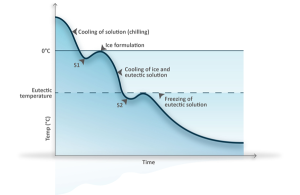 When a liquid formulation is frozen, not all the water crystallizes as ice. A portion remains in an extremely concentrated, viscous state surrounding the solutes, a region known as the freeze-concentrated matrix. Tg’ is the temperature at which this matrix transitions between a rigid, glassy state and a softer, more mobile one. It is a fundamental property of the formulation, determined by its composition.
Tc is the temperature at which the freeze-concentrated matrix loses enough structural rigidity to collapse under the stresses of drying. In practical terms, if the product temperature during primary drying exceeds Tc, the structure of the dried product will fail. The result is a collapsed lyocake or lyobead; one that may reconstitute slowly or incompletely and fail to meet stability specifications. In a manufacturing context, this means batch failure and cost; take a look our ROI calculator to see how much you can save when batch failures are reduced.
Understanding Tg’ and Tc for a given formulation, sets the upper boundary for shelf temperature during primary drying. Working within that boundary, with an appropriate safety margin, is what makes a lyophilization cycle robust and reproducible.
Crystalline vs amorphous structures: eutectic behavior
The Tg' and Tc framework applies specifically to amorphous samples. For formulations containing crystalline components, the governing thermal event is different, though equally important.
In a crystalline system, the critical event parameter is eutectic melting. A eutectic is a specific mixture of components that melts at a single, well-defined temperature lower than the melting point of any individual component. The eutectic melting temperature (Te) is the crystalline samples equivalent of Tc; exceed it during primary drying and the product will melt and fail.
Many formulations contain a mixture of amorphous and crystalline components, making it essential to correctly identify the dominant thermal behavior. Misclassifying a crystalline system as amorphous, or overlooking an eutectic event, can lead to a cycle design that appears sound on paper but produces consistent batch failures in practice. Thorough thermal characterization before cycle development removes this risk.
The analytical tools: mDSC and lyophilization microscopy (FDM)
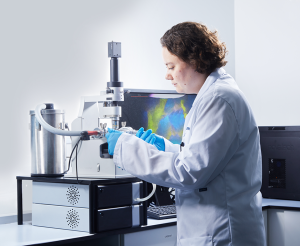 Modulated Differential Scanning Calorimetry (mDSC) measures the heat flow into and out of a sample as its temperature is changed in a controlled way. By modulating the temperature in a specific pattern, mDSC can separate overlapping thermal events that conventional DSC would miss, making it possible to accurately identify Tg’, eutectic melting events, and other critical transitions.
Lyophilization microscopy (commonly referred to as Freeze Drying Microscopy or FDM) complements and enhances mDSC results by providing direct visual observation of what happens to a sample as it is frozen and dried under conditions that mimic the lyophilizer. Scientists can observe in real time the point at which collapse occurs, confirming the Tc value suggested by mDSC and revealing the visual character of that collapse.
Working with experts
Biopharma Technology LLC's scientific team works with diagnostics and pharma companies across the US, providing full thermal characterization services as part of an integrated R&D and manufacturing offering. During pre-lyophilization analysis, our Lyostat freeze-drying microscope and Lyotherm frozen state analyzer enable us to accurately identify the thermal characteristics and frozen state mobility of your products. Using these advanced instruments and drawing on our in-depth expertise, our team ensures that your products are stable, reproducible and scalable.
If you are unsure whether your formulation has been fully characterized, or you are starting lyophilization development for the first time, schedule a 30-minute technical consultation with our lyophilization scientists. We will review your formulation, discuss the analytical work required, and give you a clear picture of the development support you need from thermal characterization and cycle design through to scale-up and transfer. Contact the BTLLC team to get started.
You may also find these resources useful: What to look for in a lyophilization CDMO partner | Lyophilized PCR master mix development – application note | Lyophilization training courses
Frequently Asked Questions: Thermal Analysis in Lyophilization Development
- What is thermal analysis in lyophilization and why is it important?
Thermal analysis in lyophilization is the process of measuring a formulation’s physical and thermal properties before a lyophilization cycle is designed. It identifies the critical temperatures that define the boundaries within which the process must operate (most importantly collapse temperature (Tc) and glass transition temperature (Tg’) for amorphous systems, and eutectic melting temperature (Te) for crystalline ones). Without this data, cycle development becomes trial and error, increasing the risk of batch failure and wasted development budget.
- What happens if thermal analysis is skipped during lyophilization development?
Skipping thermal analysis significantly increases the risk of product failure. Without knowing a formulation’s critical temperatures, it is not possible to design a cycle that keeps the product within its stable operating range. The most common consequence is collapse, poor appearance, incomplete reconstitution and compromised stability. These failures typically emerge late in development, when they are most costly to fix.
- What is the difference between collapse temperature (Tc) and glass transition temperature (Tg’) in lyophilization?
Tg’ is the glass transition temperature of the maximally freeze-concentrated solution: the temperature at which the amorphous, freeze-concentrated matrix surrounding the ice transitions from a rigid glassy state to a softer, more mobile one. Tc is the collapse temperature, the temperature at which that matrix loses sufficient structural integrity to support the product during primary drying, causing it to collapse. In practice, Tc is typically a few degrees above Tg’ and is the more directly actionable value for cycle design, as it sets the upper limit for product temperature during primary drying. Both values are formulation-specific and must be measured for each product.
- What is a eutectic and how does it affect lyophilization cycle design?
A eutectic is a specific mixture of two or more components that melts at a single, well-defined temperature lower than the melting point of any individual component. In lyophilization, eutectic behavior is relevant to crystalline systems (as opposed to amorphous ones), where the critical thermal event is eutectic melting rather than glass transition. The eutectic melting temperature (Te) is the equivalent of the collapse temperature for these systems: if the product temperature exceeds Te during primary drying, the crystalline structure melts and the product fails. Many formulations contain both amorphous and crystalline components, making correct identification of the dominant thermal behavior essential before cycle design begins.
- What is freeze drying microscopy (FDM) and what does it reveal about a formulation?
Freeze drying microscopy (FDM) (also referred to as lyophilization microscopy) is an analytical technique that allows scientists to directly observe a formulation’s behavior under simulated lyophilization conditions. A sample is frozen on a temperature-controlled microscope stage and slowly warmed under vacuum; the point at which structural collapse occurs is recorded in real time, providing direct visual confirmation of the collapse temperature (Tc). It is typically used alongside mDSC to provide a complete thermal characterization.
- What analytical techniques are used to characterize a formulation before lyophilization?
The two primary techniques used for pre-lyophilization thermal characterization are modulated Differential Scanning Calorimetry (mDSC) and lyophilization microscopy (FDM). mDSC measures heat flow through a sample as temperature changes, identifying thermal transitions such as glass transition temperature (Tg’), eutectic melting temperature (Te), and other critical events. FDM provides direct visual observation of collapse under simulated lyophilization conditions, confirming the collapse temperature (Tc).
- When should a company outsource lyophilization thermal analysis to a specialist CDMO?
Outsourcing is worth considering when an organization lacks the specialist instrumentation required (such as a lyophilization microscope or mDSC); when the formulation is complex or contains both amorphous and crystalline components requiring expert interpretation; when timelines are tight; or when an existing process is producing inconsistent results that independent expert review would help resolve.