


Understanding Thermal Analysis in Lyophilization Development
July 20, 2026Improving stability of sensitive drug products through lyophilization
Shelf life, cold chain burden and handling: the case for lyophilization as a strategic development decision
Water is the primary driver of degradation in sensitive biological products. For proteins, monoclonal antibodies, vaccines, gene therapies and diagnostic reagents in development, this intrinsic vulnerability creates challenges including short shelf life, high storage costs, complex logistics and restricted market access.
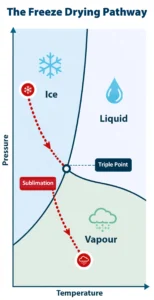 The more demanding the cold chain a product requires, the higher its cost to manufacture, distribute and maintain in the field. Rising global temperatures are compounding this pressure, increasing the thermal stress that cold chain infrastructure must work against and raising the risk of excursions in precisely the markets where that infrastructure is least reliable.
Lyophilization addresses these challenges at source. By removing water from a frozen product under vacuum, it converts an unstable liquid formulation into a stable, dry solid. Outcomes include an extended shelf life supporting global distribution, a substantially reduced cold chain burden with environmental and cost benefits, and handling properties that simplify end use.
The stability challenge: why liquid formulations fall short
Many of the most therapeutically important products in development today are inherently unstable in liquid form. Proteins and monoclonal antibodies undergo aggregation and oxidation in aqueous solution, eroding potency and introducing immunogenicity risk. mRNA molecules are particularly vulnerable: they hydrolyze readily in the presence of water and are susceptible to enzymatic degradation. Viral vectors, cell-based therapies and diagnostic reagents used in PCR assays, lateral flow tests and immunoassays present comparable instability profiles, degrading continuously in solution even under refrigeration.
For these products, liquid formulation is a constraint. The challenge affects development decisions and has a direct bearing on the commercial viability of a product.
How lyophilization eliminates the conditions for degradation
 Lyophilization removes water, the medium for degradation. The product is frozen to convert free water to ice, then primary drying under vacuum removes that ice by sublimation. Secondary drying reduces residual bound water to a level at which molecular mobility, and therefore reactivity, is negligible.
However, freezing and drying are themselves stressful for sensitive biological molecules. Ice crystal formation, concentration effects and temperature extremes can all damage structure and reduce activity. Protecting the active material through lyophilization starts with how the product is formulated.
Before lyophilization begins, scientists add excipients to the liquid formulation specifically to protect sensitive molecules through the process. Cryoprotectants such as sucrose or trehalose form a protective glassy matrix around proteins, antibodies or nucleic acids, preserving their structure and biological activity. Bulking agents such as mannitol provide the physical structure of the dried product, supporting reconstitution and long-term stability.
The result is a formulation that retains the potency, activity and physical characteristics of the original liquid in a form that can be stored and reconstituted reliably on demand.
Extended shelf life: the commercial and regulatory case for lyophilization
For pharmaceutical companies, a lyophilized product that remains stable for two or more years reduces expiry losses, extends distribution windows and opens markets that a liquid product with a short shelf life cannot reach. For a biologic or advanced therapy with a complex, costly manufacturing process, the commercial case for maximizing shelf life is significant.
Regulatory approval of a lyophilized drug product requires shelf life to be proven under defined storage conditions. ICH Q1A(R2) guidelines (adopted by the FDA and regulatory agencies worldwide) set out the stability testing framework. A product whose formulation and thermal properties have been thoroughly understood before cycle development begins is well placed to generate consistent stability data. BTLLC’s R&D analytical services include stability studies as part of an integrated development offering, ensuring shelf life claims are built on robust data from the outset.
The cold chain burden: cost, complexity and a changing climate
 Maintaining temperature-controlled infrastructure from manufacture to the patient is one of the most significant cost and complexity burdens in biopharmaceutical distribution. For liquid biologics requiring ultra-cold storage, the challenge is acute: specialized equipment, validated transport conditions and continuous monitoring are required at every point in the supply chain. As global temperatures rise, the energy required to maintain these conditions increases, cold chain excursions become more likely, and infrastructure gaps in tropical and low-resource markets widen.
Lyophilization substantially reduces this burden. A product that requires only ambient or refrigerated storage demands far less distribution infrastructure. The financial impact is material: clients moving from liquid to lyophilized formats often see substantial reductions in storage and production costs as a result.
Ultra-cold storage is also extraordinarily energy-intensive; shifting to ambient conditions cuts the carbon footprint of the distribution chain significantly. Reduced product weight and volume mean fewer, lighter consignments, lower fuel consumption and a smaller storage footprint.
In diagnostics, the lyobead format (in which lyophilized reagent is produced as pre-metered spheres rather than vials or cakes) extends these advantages further: compact, lightweight and stable at ambient temperature, it is designed for field and point-of-care use where cold chain infrastructure is limited. BTLLC's work on lyophilized PCR master mix development and AA5V viral vector stability shows how these benefits translate across both diagnostics and advanced therapy applications.
Handling advantages: simpler, safer and faster at the point of use
 Lyophilized products reconstitute rapidly and reliably when water or buffer is added. For injectable biologics, consistency of reconstitution is directly relevant to patient safety: a poorly reconstituted product may contain aggregates or deliver an inaccurate dose, both of which carry clinical risk.
Lyophilized formats also eliminate continuous cold storage at the point of dispensing, reducing workflow complexity in clinical settings. In diagnostics, the handling advantages are more pronounced. The lyobead format delivers pre-metered, single-use doses that eliminate manual pipetting, removing a significant source of user error in point-of-care settings where operators may not have laboratory training. Beads dissolve in seconds when sample is added and can be produced in formats compatible with tubes, vials, 96-well plates and lateral flow strips. BTLLC’s diagnostics manufacturing capability includes lyobead production at scale using proprietary LyobeadPRO technology.
Getting lyophilization right: why development decisions determine outcomes
Stability, cold chain and handling advantages depend on how the development process is designed. Formulation decisions, cycle design, analytical characterization and scale-up planning all determine whether a lyophilized product achieves its potential.
Biopharma Technology LLC’s pharma CDMO and diagnostic CDMO services cover the full development pathway from formulation and thermal characterization through cycle development, stability studies, scale-up and contract manufacturing. All work is conducted from our ISO 9001 and ISO 13485 certified facility in Carlsbad, California, with full client IP ownership throughout.
If you are evaluating lyophilization for a new product or looking to optimize an existing process, schedule a 30-minute technical consultation with our lyophilization scientists. We will review your product requirements, discuss the development pathway, and give you a clear picture of how we can support you from formulation through to transfer. Contact the BTLLC team to get started.
FAQs on improving the stability of sensitive drug products through lyophilization
- Why are biological drug products difficult to store and distribute in liquid form?
Biological drug products are inherently unstable in aqueous solution because water enables the degradation reactions that erode their potency and safety. Proteins and monoclonal antibodies aggregate, deamidize and oxidize in the presence of water; mRNA molecules hydrolyze and are susceptible to enzymatic degradation by RNase; viral vectors and cell-based therapies present comparable instability profiles. Even under refrigeration, degradation occurs continuously, limiting shelf life and constraining how far a product can travel before it reaches the patient. For many advanced therapies and biologics, liquid formulation is a constraint rather than a solution.
- What is lyophilization and how does it improve product stability?
Lyophilization is a drying process that removes water from a biological product by freezing it and then applying a vacuum to sublime the ice directly to vapor, bypassing the liquid phase. A secondary drying stage removes residual bound water, reducing moisture to a level at which molecular mobility - and therefore reactivity - is negligible. By removing water, lyophilization eliminates the medium in which most degradation reactions occur, converting an unstable liquid formulation into a stable dry solid that can be stored for months or years without loss of potency or activity.
- How does lyophilization extend the shelf life of sensitive drug products?
Lyophilization extends shelf life by removing water, which is the primary driver of the chemical, biological and microbial degradation that limits stability in liquid formulations. In the dry state, molecular mobility is negligible and most degradation pathways are effectively arrested. A well-formulated lyophilized product can achieve shelf life of two years or more under ambient or refrigerated conditions, compared to weeks or months for the equivalent liquid. Demonstrating this stability to regulators requires testing under the conditions set out in the ICH Q1A(R2) guideline, adopted by the FDA and regulatory agencies worldwide.
- What role do excipients play in lyophilization?
Excipients are added to the liquid formulation before lyophilization specifically to protect sensitive molecules through the stresses of freezing and drying. Cryoprotectants such as sucrose or trehalose form a protective glassy matrix around proteins, antibodies or nucleic acids, preserving their structure and biological activity through ice crystal formation and concentration effects that would otherwise cause damage. Bulking agents such as mannitol provide the physical structure of the dried product, supporting mechanical integrity and reliable reconstitution. Excipient selection is one of the most consequential decisions in lyophilization development: the wrong choice can result in product collapse, poor reconstitution or failed stability testing.
- What is a lyobead and how does it differ from other lyophilized formats?
A lyobead is a lyophilized product produced in the form of small, discrete spheres rather than the cake or plug formed in a conventional vial or well. Droplets of liquid formulation are dispensed directly into the lyophilizer, producing individual beads each containing a precise, pre-metered dose of the active material. Because each bead is a single-use unit, lyobeads eliminate the need for manual pipetting at the point of use, reducing user error in point-of-care and field settings. Their high surface area to volume ratio enables rapid reconstitution, and they can be produced in formats compatible with tubes, vials, 96-well plates and lateral flow strips, making them highly versatile for diagnostic applications.
- How does lyophilization reduce cold chain costs and complexity?
Lyophilization reduces cold chain burden by enabling products that would otherwise require ultra-cold storage to be stored and distributed at ambient or standard refrigerated temperatures. This substantially reduces the infrastructure required at every point in the supply chain, from specialized freezers and validated transport equipment through to continuous monitoring. The financial impact is significant: clients moving from liquid to lyophilized formats often see substantial reductions in storage and production costs as a result. Weight and volume reduction achieved by removing water also lowers shipping costs and fuel consumption per unit distributed, with a corresponding reduction in carbon footprint.
- When should a pharma or diagnostics company consider lyophilization for a new product?
Lyophilization is worth considering when a product is inherently unstable in liquid form and cannot achieve the required shelf life or distribution range without it; when cold chain costs or complexity are limiting commercial viability or market access; when the product is intended for point-of-care, field or low-infrastructure deployment where continuous refrigeration cannot be assured; or when handling simplicity at the point of use is a clinical or commercial priority. The earlier lyophilization is considered in development, the more effectively formulation and cycle design can be optimized to realize its full benefits. Retrofitting lyophilization to a product already developed for liquid formulation is possible but significantly more complex and costly than building it in from the outset.